What Is a Portrait System? Why One Good Portrait Is No Longer Enough
Updated: Aug 10

By Hart Getzen — executive portrait photographer, producer, and publisher. Austin-based, working nationwide. PPA member; work held in the collection of the New York Historical.
In short: A single portrait gives you one usable image. A portrait series gives you a small, coordinated set — a primary portrait, an alternate expression, and horizontal, vertical, and square crops, usually with an environmental frame — all made in one session and prepared so each image works in the specific place it appears. For anyone whose work puts them in public — founders, executives, artists, filmmakers — the system, not the single frame, is usually what the job actually requires.
A single portrait gives you one good photograph of yourself. A portrait series gives you the right photograph for every place you show up.
That distinction sounds small until you watch one image try to do every job at once. The same file gets squeezed into a square profile avatar, stretched across a website banner, dropped into a press kit, and pasted into a pitch deck — fitting none of them well. It crops awkwardly, it reads at the wrong scale, and it starts to feel dated precisely because it is everywhere.
The image didn’t fail. It was asked to do six jobs when it was built for one.
Your portrait no longer lives in one place. It moves through your website, LinkedIn, press features, investor and donor materials, speaker pages, gallery, distributor and festival listings, search results, and the AI summaries that increasingly form someone’s first impression of you. Each surface wants a different shape and a different register — and each is a place where a weak or wrong-fitted image applies a small, persistent discount to how seriously you’re taken.
What is a single portrait?
A single portrait is exactly what it sounds like: one strong, considered photograph of a person. Done well, it’s clear, current, and flattering, and it answers the basic questions — what do you look like, and what kind of presence do you carry? For some uses, that is genuinely enough. The limit isn’t quality; it’s range. One image can be excellent and still be wrong for two-thirds of the places you need to appear.
What is an AI-ready portrait series?
A portrait series is a small, coordinated set of images made in a single session and planned around how they will actually be used. Same person, same day, one consistent visual identity — but built so there is a right image for each context, instead of one image forced into all of them. I build these as coordinated, AI-ready portrait series — the set, plus the delivery layer that makes it legible to people, search engines, and AI.
A typical AI-ready portrait series includes:
• a primary portrait — the anchor image: clean, current, authoritative, and composed to carry presence at any size
• an alternate expression — a warmer, more approachable read of the same person, for contexts where the primary would land as too formal
• horizontal, vertical, and square crops — composed deliberately, not cropped after the fact, so the frame keeps its balance in every shape
• an environmental frame or two — the person in the world of their work; these carry context, and they tend to age more slowly than tight, trend-driven crops
• a clean identification option — the straightforward, consistent headshot for directories and credentials, covered in the same session so it isn’t commissioned separately later
• the delivery layer that makes it usable — descriptive filenames, alt text, captions, embedded metadata, print and web sizes, and placement guidance

The point isn’t more photographs for their own sake. It’s a more useful structure for the way images are actually used — range, not volume. Each frame is made knowing where it will go, and that intent, decided before the shutter, is the whole difference between a series and a pile of pictures.
That intent is most visible in the crops. A frame composed to hold up wide is not the same photograph cropped narrow — the balance, the negative space, and the position of the subject are all decided for the shape the image will finally occupy.

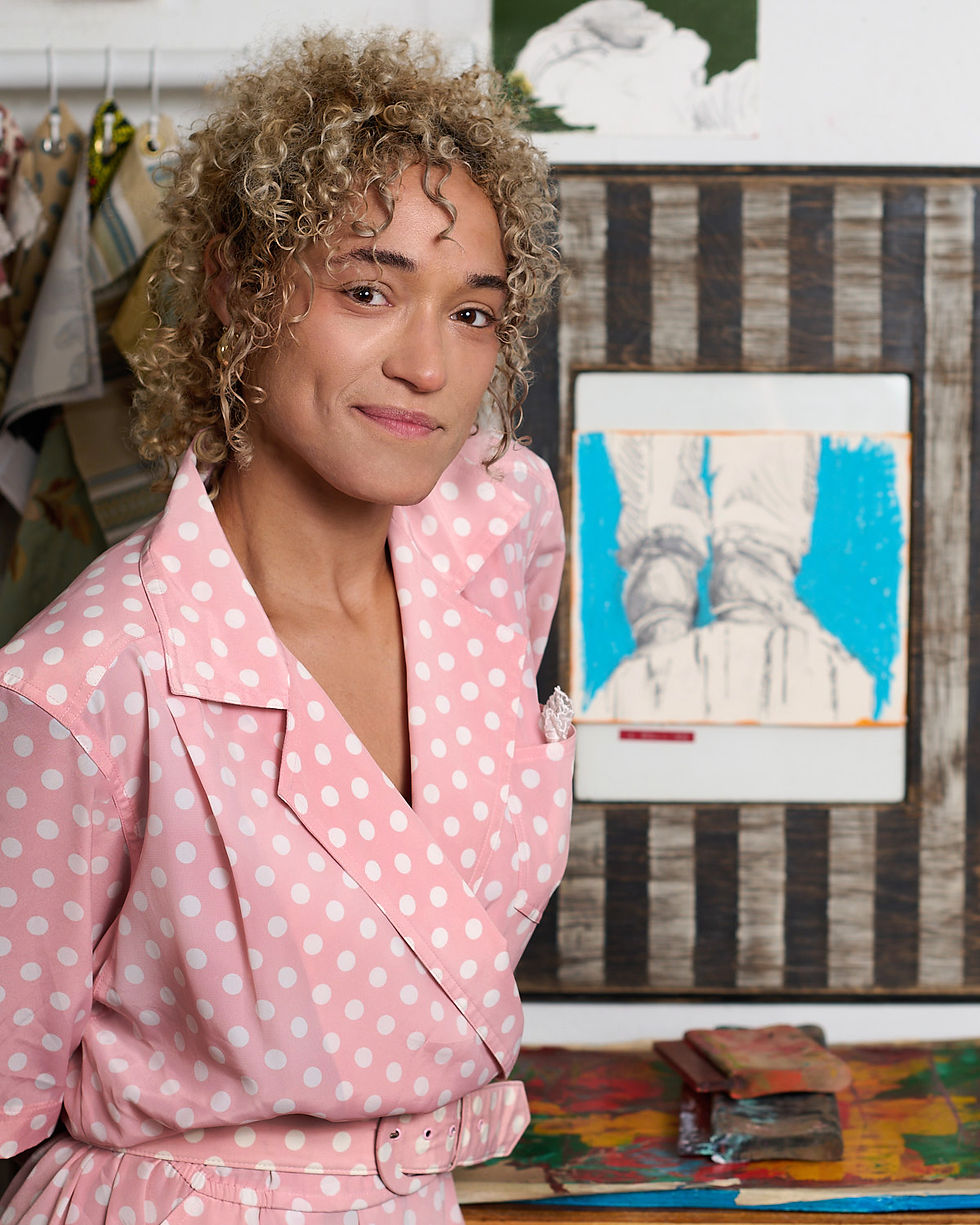

A portrait series in practice: Allie Gallion
To make this concrete, consider an artist. Allie Gallion is a Texas-born artist working between Austin and the United Kingdom, with a practice rooted in street art, screen printing, sculpture, and community engagement — work she discusses in a Voyage Austin interview published under her full name, Alexandra Gallion.
She is currently producing a collection of horse sculptures for one of Austin's significant events this year. That is precisely when a portrait system stops being a nice-to-have. A show announcement, a press enquiry, a catalogue listing, and a dozen profiles all need a different shape of the same person, often in the same week, and none of them wait while a session gets booked.
It also changes what the photographs are. These are not staged approximations of an artist at work — they are the record of one, made while the work was being made. That is where a portrait gets its authority: not from lighting, but from being true.
An artist’s own image has an unusually wide set of places to live: a gallery show card, a press feature or interview, the artist bio on her own site, a print-shop listing where collectors buy the work, an expo or festival catalogue, social profiles — and, increasingly, the search results and AI summaries that describe her before a curator, collector, or collaborator ever meets her.
No single frame serves all of that. The portrait that reads as composed and self-possessed beside a gallery wall text is not the one that feels right next to a candid studio interview; the crop that works as a square profile picture loses everything as a horizontal banner across the top of a show page. A portrait series covers the range: a primary portrait for press and her own site, an environmental frame of her putting work up in public, a square crop tuned for profiles, a vertical for editorial features, and a wide frame for a show-page banner. One session, one coherent identity, many correct uses.
For an artist, the environmental frame does more than decorate. The work going up is the story — it ties the face to the hands, the paste, and the moment the piece leaves the studio and becomes public, which is the connection a collector or curator is really after when they ask who made this.

The frame that puts the work in public — where a collector or curator can see not just who made it, but that it gets made.
Why this matters for search and AI discovery
A photograph doesn’t generate visibility on its own. But a portrait series, prepared and placed well, gives search and AI systems cleaner material to work with. SEO governs how people find you through search. AEO — answer engine optimization — concerns how clearly the public record answers direct questions about you. GEO — generative engine optimization — concerns how AI systems interpret and represent you when they draw on that record, and how clearly you’re tied to the work and organization you belong to.
For photography, the implication is practical: a finished image shouldn’t be an isolated file. With descriptive filenames, accurate alt text, captions that name the person, role, and organization, embedded metadata, and consistent placement across a person’s own pages and profiles, a portrait becomes legible source material — the kind people, search engines, and AI systems can all read correctly. That preparation is the part most photography ignores, and it is built into how a system is delivered.
Accurate is the operative word. Alt text that describes a room the subject wasn’t in, or a role she doesn’t hold, teaches the same systems the wrong thing — and does it permanently, at scale. The delivery layer is only an asset when it is true.
Done well, this is what helps someone like Allie surface when a curator or collector searches her name — or when someone asks an assistant which artists are working between Austin and the UK, and gets an answer with the right face attached.
Even a simple session can do this
None of this requires an elaborate production. Even a focused, single-person session can be built as a small series: a primary portrait, a secondary expression, horizontal, vertical, and square crops, one environmental frame, and the metadata and placement guidance to publish it well. The session stays simple; the delivered set becomes far more useful.
It also has to survive the day you actually get. Locations change, access falls through, light goes. A system planned around what each image has to do — rather than around one hoped-for backdrop — absorbs that. The environmental frame in this piece is not the one that was scouted; it covers the same job better, because the requirement was context, not a particular room.
When the need is broader: image libraries
When more is required — a founder raising capital, an institution speaking to donors, an artist with show after show, a company explaining its people and process — the same logic scales into an image library: a coherent body of original photographs created for repeated use across websites, bios, press kits, proposals, and social platforms. The goal isn’t volume; it’s never being caught without the right image for the moment in front of you.
When that library is organized and labeled so it reads clearly to search and AI systems, it becomes an AI-ready image library. The phrase matters: AI-ready does not mean AI-generated. It means AI-readable — original photography, planned, captioned, named, and deployed so people and machines can understand the person, role, company, and work being represented.
And off the screen: Brand Editions
Some images should also leave the screen. Brand Editions turn selected portraits and libraries into printed booklets, leave-behinds, and presentation pieces — for introductions, fundraising, gallery, festival and investor conversations, and premium proposals. The structure is simple: Portrait Series create the primary visual identity; Image Libraries create the broader visual record; AI-Ready Image Libraries make that record legible to search and AI; Brand Editions turn it into a physical object.
Which one do you need?
• a single portrait — if the image will live in one or two low-stakes places and basic recognition is the goal.
• a portrait system — if the image will appear across several surfaces (site, LinkedIn, press, decks, show pages) and must fit each one.
• an image library — if more than one person, or the place, process, and tools of the work, need photographing for ongoing use.
• an AI-ready image library — if visibility in search and AI-mediated systems matters, and filenames, captions, metadata, and page context should be planned, not left to chance.
• a Brand Edition — if the work should also exist as a printed introduction or presentation piece.
The better question
The better question was never “how many photos do I need?” It’s what each image has to do after it’s delivered. If you only need to be recognized in one place, a single portrait is enough. If you need to be understood, trusted, found, and represented accurately everywhere you appear, you don’t need another photo. You need a system.
A photograph shows what you look like. An AI-ready portrait series makes sure the right version of you shows up, in every place it needs to, for both the people and the machines now doing the looking.
That’s where the work begins.
Frequently asked questions
Is a portrait system just buying more photos?
No. It’s one session planned so each image fits a specific use, plus the delivery layer — crops, filenames, alt text, captions, metadata, placement — that makes them usable. The value is coordination, not count.
How many images are in a portrait system?
Enough to cover your real surfaces — typically a primary portrait, an alternate expression, an environmental frame, and square, horizontal, and vertical crops. It’s scoped to where you actually appear, not to a fixed package.
How long does a portrait system last?
Often a few years. Refresh it when your role, positioning, or appearance changes meaningfully. Environmental frames tend to age more slowly than tightly cropped, trend-driven ones.
How is this different from a headshot session?
A headshot session optimizes for one consistent identification image. A portrait system is planned around several real-world uses from the start — the distinction covered in the previous piece in this series, Headshot vs. Executive Portrait.
What if the location changes on the day?
The system holds, because it is planned around jobs rather than backdrops. If a scouted space is unavailable, the environmental frame is rebuilt around process — hands, tools, work in progress — which usually carries more meaning than the room did.
Can a portrait system support SEO, AEO, and GEO?
Yes — because the value comes from how the images are prepared and published (filenames, alt text, captions, metadata, placement), not from the photograph alone.
Do I need a studio or an environmental portrait?
Often both. A studio frame emphasizes the person; an environmental frame adds the context of the work. A system can include both from one session.
What about the files themselves?
They’re delivered named, tagged, and captioned for search and AI discovery, in both print and web sizes — ready to place, not raw images to sort through later.
How is this different from an image library?
A portrait system covers one person’s core needs. An image library is broader — multiple people, places, process, and tools — for ongoing organizational use.
Hart Getzen builds executive portrait systems, institutional image libraries, AI-ready image libraries, and printed brand editions for founders, leaders, artists, and institutions. To discuss a commission, get in touch.
Comments